
A lot of older workers still talk about AI like it is a future problem.
Gen Z does not have that luxury. For them, AI showed up before their careers were even fully built. ChatGPT launched while many of them were still in school. Entry-level hiring tightened at the same time. Employers started asking for AI fluency before many graduates had even landed their first real job. So while some people are still debating whether AI will matter, younger workers are already making career decisions as if it does.
That shift is worth paying attention to. It suggests Gen Z is not just anxious about AI. They are behaving strategically around it. They are building skills more often, using AI earlier, rethinking traditional degree-to-job pipelines, and looking for roles that combine technical fluency with human judgment. In other words, they are already trying to make themselves harder to replace and easier to hire.
The phrase “AI-proof” can be a little dramatic. No career is fully untouchable. Still, the instinct behind it is smart. The goal is not to find one magical job that AI can never affect. The real goal is to build a career that stays valuable as tools change. Gen Z seems to understand that earlier than many people expected.
Why Gen Z feels the pressure sooner
The entry-level market is sending obvious signals.
Randstad says vacancies for entry-level roles have dropped by 29 percentage points since January 2024. The World Economic Forum’s Youth Pulse 2026 found that two-thirds of young respondents think AI will reduce the number of entry-level roles available over the next three years. Deloitte found that 61% of Gen Z and millennial respondents worry generative AI will make it harder for younger generations to enter the workforce because it can automate tasks that used to belong to entry-level workers.
That does not mean the bottom has fallen out of the market. Handshake’s research says the evidence for AI displacing early talent is still mixed, and it found no clear pattern of sharper hiring slowdowns in roles thought to be more exposed to AI. However, younger workers do not need a full collapse to change their behavior. They only need enough uncertainty to start hedging.
And they clearly are hedging. In Handshake’s Class of 2025 report, 62% of graduating seniors said they were somewhat or very concerned about the impact of generative AI on their careers, up from 44% two years earlier. At the same time, 77% said they expected to use generative AI tools in the workplace once they graduated. That is a very Gen Z response: worry about the disruption, then learn the tool anyway.
What “AI-proofing” actually looks like
The smart version of AI-proofing is not hiding from AI. It is getting harder to substitute.
That usually means five things: learning the tools, building human skills that still matter, choosing work with more judgment and real-world complexity, favoring practical experience, and keeping your path flexible. Those moves line up closely with what current surveys show Gen Z is already doing.
1. They are learning AI instead of pretending it will go away
This is probably the clearest signal.
Deloitte found that 74% of Gen Z respondents believe generative AI will affect the way they work within the next year. It also found that 57% are already using generative AI in their day-to-day work to some extent. Randstad says 55% of Gen Z workers already use AI to problem-solve at work, the highest share of any generation. Meanwhile, the World Economic Forum says 60% of young people in its Youth Pulse 2026 survey are already using AI for skills-building.
That matters because AI literacy is quickly becoming normal workplace currency. LinkedIn says AI is a major reason skills are shifting, and its data suggests 70% of the skills used in most jobs will change between 2015 and 2030. It also reports that 71% of leaders would rather hire a less experienced candidate with AI skills than a more experienced one without them. So Gen Z is not wrong to see AI fluency as basic career insurance.
2. They are doubling down on human skills too
This part is easy to miss.
A lazy reading of the AI moment says young workers should obsess over tools and forget everything else. The better reading is almost the opposite. Deloitte found that while Gen Z is focused on technical training, they still rate soft skills like communication, leadership, empathy, networking, time management, and industry knowledge as even more important for career progression. More than eight in 10 Gen Z respondents in Deloitte’s survey said soft skills are somewhat or highly required.
The World Economic Forum’s Future of Jobs data points in the same direction. Employers expect 39% of workers’ core skills to change by 2030, yet the most important skills still include analytical thinking, resilience, flexibility, leadership, motivation, technological literacy, empathy, and curiosity. In other words, the people who win are not just tool users. They are adaptable tool users who can also think, communicate, and make sound judgments.
That is one reason “AI-proofing” works better as a skill strategy than a job-title strategy. A job can change fast. A blend of technical fluency and human judgment travels well.
Read more posts from Nerd XP
Stay up-to-date on the latest news in the world of finance, geek culture, and skills.
- Central Banks Are Spelling Out a Multi-Asset Risk Map
 Most investors still talk about risk one shelf at a time. Stocks are risky. Bonds are defensive. Credit is someone else’s problem. Central banks are telling a different story now. Their latest warnings read less like isolated market commentary and… Leia mais: Central Banks Are Spelling Out a Multi-Asset Risk Map
 - Xbox and Gears Still Have Real Momentum
 For all the talk that Xbox has become too scattered, too platform-agnostic, or too far removed from the old console-war script, today tells a different story. Microsoft just announced that its June 7 Xbox Games Showcase will be followed immediately… Leia mais: Xbox and Gears Still Have Real Momentum
 - TikTok Wants to Be a Lender, Not Just a Platform
 For years, the TikTok story was simple: attention first, ads second, shopping maybe third. That model is changing fast. Reuters reported on March 31 that TikTok is seeking approval from Brazil’s central bank for two licenses that would let it… Leia mais: TikTok Wants to Be a Lender, Not Just a Platform
 - Portfolio Careers Beat the Side-Hustle Fantasy
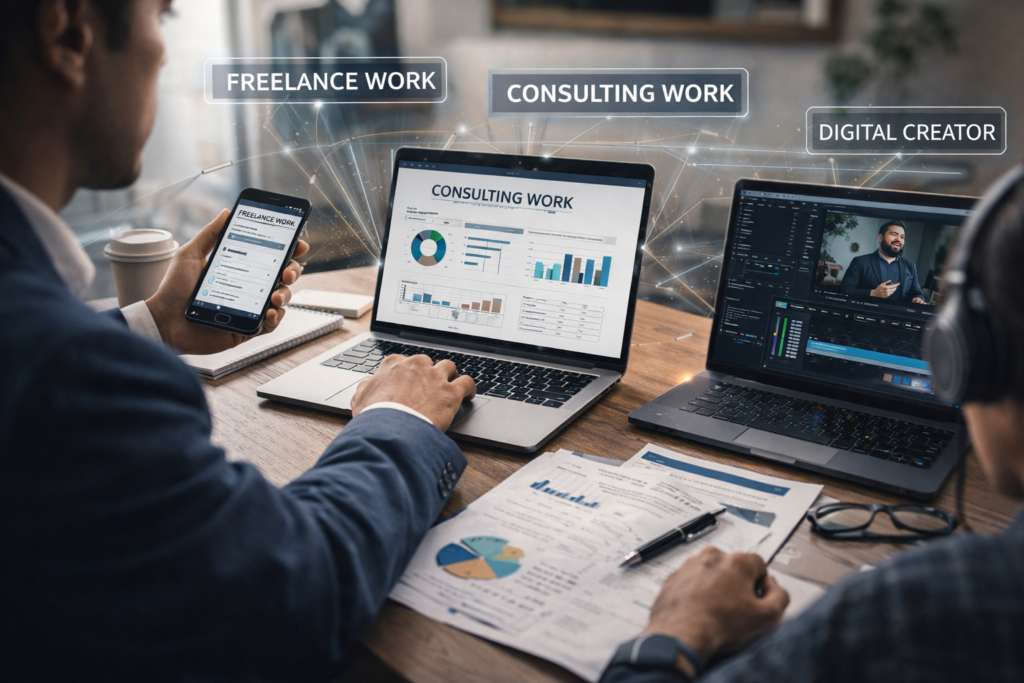 For years, people were sold a very specific dream. Start a side hustle. Work nights for a while. Then escape your job, replace your income, and finally control your life. That dream still sounds good. However, real life keeps exposing… Leia mais: Portfolio Careers Beat the Side-Hustle Fantasy
 - Why McCormick and Unilever Put Flavor on Wall Street
 A spice rack is not supposed to feel like a market-moving asset. Yet on March 31, 2026, McCormick and Unilever made flavor a real Wall Street conversation. Their deal to combine Unilever’s foods business with McCormick was valued at about… Leia mais: Why McCormick and Unilever Put Flavor on Wall Street
 - Private Credit Stress Is Getting Visible
 For a long time, private credit’s biggest danger was that you could not see it clearly. That was the trade. Investors got higher yields, smoother marks, and less daily market noise. In return, they accepted opaque portfolios, illiquid structures, and… Leia mais: Private Credit Stress Is Getting Visible
Gen Z is rethinking the old playbook
The traditional script used to feel simple: get the degree, get the entry-level job, move up from there.
That script looks less stable now. Deloitte found that many Gen Z respondents are rethinking how they build workforce skills, including whether college is the only route worth pursuing. In the survey, 31% said they decided not to pursue higher education, while others reported concerns about tuition, limited practical experience, and whether college curricula stay relevant to the job market. Some are exploring vocational qualifications, apprenticeships, or trades instead.
This does not mean Gen Z is anti-education. It means they are more skeptical about paying for theory without employable proof. That is a pretty rational reaction in a labor market where employers increasingly care about what you can do, not just what you studied. Handshake’s data reinforces this applied mindset: seniors are now noting AI skills on their resumes at twice the rate of the Class of 2022, and in one sample, 74% mentioned AI in the context of real experiences rather than just coursework.
That detail matters. It shows the shift from “I took a class on this” to “I used this in real work.” Employers tend to trust the second signal more.
3. They are diversifying beyond the obvious paths
Computer science is the clearest example.
Handshake found that Class of 2026 computer science majors are among the most pessimistic students about their career prospects. Seventy percent are at least somewhat pessimistic, and 64% of pessimistic computer science majors say generative AI is part of the reason. Nearly 30% say they would have chosen a different major if they had known how fast generative AI would develop.
Yet the response is not simple retreat. It is diversification. Handshake says recent computer science graduates are applying more often to roles in IT, computer systems, and cybersecurity, while also showing rising interest in finance, marketing, and project management. That is exactly what AI-proofing looks like in real life: not throwing away your skills, but translating them into adjacent roles where systems thinking, technical fluency, and problem-solving still matter.
What the rest of the workforce can learn
Gen Z’s approach is not perfect. Some of it is driven by anxiety, and anxiety can distort judgment.
Still, the broader instinct is solid. They are not betting on one frozen version of the labor market. They are assuming work will keep changing, so they are building for flexibility. They are learning new tools before they are forced to. They are protecting the human skills that still create trust and value. They are looking for practical experience, not just credentials. And they are keeping multiple lanes open.
That is a much healthier response than either panic or denial.
If you are already in the workforce, the lesson is simple. Do not ask, “What job is safe forever?” Ask better questions. What part of my work is easiest to automate? What part gets stronger with AI? What proof can I build that shows I can work with modern tools? Which human skills make me more valuable when software handles the routine layer? Those are the questions Gen Z is already answering, whether they use the phrase “AI-proofing” or not.
The bottom line
Gen Z is already AI-proofing career plans because they have had to.
They entered adulthood in a labor market shaped by AI headlines, tighter entry-level hiring, and employers who increasingly reward adaptability over comfort. So they are doing what smart workers do when the map changes: they are learning the tool, widening the skill stack, questioning old assumptions, and staying flexible.
That does not make them panic-proof. It does make them realistic.
And realism is useful here. The future of work probably will not belong to people who ignore AI. It also will not belong to people who worship it. It will belong to people who can use new tools without becoming dependent on them, and who can pair technical fluency with judgment, resilience, and real-world usefulness. Gen Z seems to be figuring that out early. The rest of the workforce would be smart to catch up.
WolfBuilder
Build of the Week — 3 Steps:
- Pick one part of your career plan that feels most exposed to AI.
- Add one skill this week that makes you more useful with, not against, the tool.
- Create one proof-of-work example that shows judgment, not just tool use.