
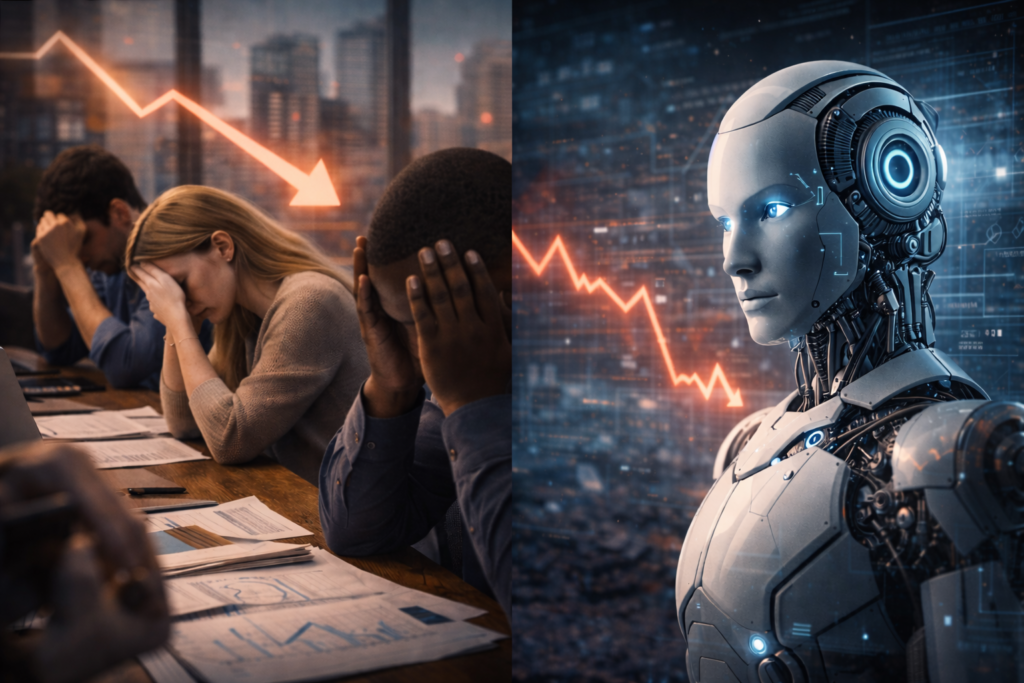
A lot of workers are not just tired right now. They are wary.
That matters because the global mood at work has clearly weakened. Gallup’s State of the Global Workplace 2026 says only 20% of employees worldwide were engaged in 2025, down from 23% in 2022 and 2023. At the same time, 64% were not engaged, 16% were actively disengaged, and daily stress stayed elevated at 40%, while anger and sadness remained above pre-pandemic levels.
Now add AI to that environment. ManpowerGroup’s 2026 Global Talent Barometer found that regular AI use jumped to 45% of workers, yet confidence in using technology fell by 18%. In the same data, 43% of workers said they fear automation may replace their job within the next two years, and 63% reported burnout. Reuters, citing Randstad’s global survey, found four in five workers expect AI to affect their daily tasks, while nearly half fear it will benefit corporations more than workers.
That does not prove AI is the single reason engagement is falling. It does suggest something more realistic: AI anxiety is landing on top of an already fragile workforce. When people feel uncertain about their future, undertrained for what comes next, and unclear about whether new tools are helping them or threatening them, it becomes much harder to stay connected to work.
The global mood really is getting worse
The cleanest way to understand the moment is this: fewer workers feel psychologically attached to their jobs, and more workers feel emotionally strained.
Gallup’s 2026 global data shows engagement fell for the second straight year to its lowest level since 2020. Wellbeing improved slightly to 34% thriving, but the emotional picture stayed rough: 40% of employees reported a lot of stress the previous day, 22% reported anger, 23% sadness, and 22% loneliness. Europe was the least engaged region at 12%, while the U.S. and Canada sat at 31%.
ADP’s 2026 Today at Work report paints a similarly uneasy picture. Only 22% of global workers strongly agreed their job was safe from elimination, and just 26% felt confident they had the skills needed to advance. Nearly half said it had become harder to change jobs than a year earlier. ADP also found that workers who felt their jobs were safe were six times more likely to be fully engaged and more than three times more likely to say they were highly productive.
So the backdrop matters. People are not meeting AI from a place of calm, trust, and surplus energy. They are meeting it while already feeling stretched, cautious, and harder to reassure. That is one reason AI adoption can feel more threatening than leaders expect.
Read the latest posts from Skills XP
News about personal growth and skills development at Nerd XP.
- Global Engagement Falls as AI Anxiety Rises
 A lot of workers are not just tired right now. They are wary. That matters… Leia mais: Global Engagement Falls as AI Anxiety Rises
 - The Resume Is Losing Ground to Show-Your-Work Hiring
 A lot of job seekers are starting to feel the same thing: the resume still… Leia mais: The Resume Is Losing Ground to Show-Your-Work Hiring
 - Workers Feel Like They’re Training AI Replacements
 A lot of workers are having the same uneasy thought right now: Am I helping… Leia mais: Workers Feel Like They’re Training AI Replacements
AI anxiety is rising, but the story is more complicated than “workers hate AI”
The interesting part is that workers are not simply rejecting AI.
ADP found that frequent AI users were often more engaged, less stressed, and more positive about their teams than nonusers. However, those same workers did not feel more productive. In fact, daily AI users were four times more likely than nonusers to say they were less productive than they could be. Workday reported a similar pattern in January 2026: 85% of employees said AI saved them one to seven hours per week, but much of that time was getting eaten by rework, such as fixing mistakes, rewriting content, and double-checking outputs.
That is a useful correction. The problem is not just the existence of AI. In many cases, the problem is unmanaged adoption. Workers can see the upside, but they can also feel the friction: new tools, unclear expectations, hidden checking work, and more pressure to “keep up” without a clear roadmap.
Reuters’ January 2026 reporting on Randstad showed the same tension. Workers were broadly enthusiastic about AI’s possibilities, but many were also skeptical that employers mainly wanted lower costs and more efficiency. That gap between excitement and suspicion is where anxiety starts to poison engagement.
Where AI anxiety turns into disengagement
1. Workers do not know where they fit next
Uncertainty is a powerful engagement killer.
ADP found that only 22% of workers felt safe from job elimination, and more than half of the global workforce reported no recent training or mentorship. JFF’s March 2026 survey adds a sharper warning: only 36% of workers said they had the training and resources they needed to use AI in their jobs, down from 45% a year earlier, and 47% said they need new skills because of AI’s impact.
That creates a bad psychological loop. People are told AI is changing everything, but they are not shown how they personally stay valuable inside that change. When workers cannot picture their future role, they stop investing emotionally in the current one.
2. Trust is getting weaker
Deloitte’s 2026 Human Capital Trends work is especially blunt here. It says AI is “blurring authorship and eroding confidence” and warns that organizations are building “cultural debt” when they fail to address how AI changes trust, fairness, and accountability. In Deloitte’s survey, 42% of workers said their organization rarely evaluates AI’s impact on people, and 80% of leaders, managers, and workers said they worry coworkers are using AI to appear more productive than they really are.
That kind of suspicion corrodes engagement fast. If workers start wondering who really did the work, what counts as effort, or whether AI is quietly changing performance standards, the social glue of work gets thinner. Engagement is not just about perks or motivation. It is also about trust in the rules of the game.
3. Guidance is lagging behind adoption
Thomson Reuters Institute found that AI use in professional services has nearly doubled over the past year, yet support systems are lagging badly. Around 40% of professionals said they received contradictory guidance about AI use, while half said no client conversations about AI had happened at all. The institute also found that job displacement fears had doubled over the prior year in its surveyed fields.
That is exactly how organizations create unnecessary anxiety. People can handle change better than leaders think. What they handle poorly is mixed signals. “Use the tool, but be careful.” “Experiment, but do not make mistakes.” “Move faster, but we will not tell you how this affects your role.” That combination drains confidence.
4. Managers are weakening right when workers need them most
Gallup says the recent drop in global engagement is being driven heavily by managers, whose engagement has fallen more sharply than individual contributors. That matters even more now because Gallup’s U.S. workforce survey found the strongest predictor of whether employees use AI, aside from technical integration, is whether their direct manager actively champions it.
So this is not just a tooling problem. It is a management problem. If managers are burned out, less engaged, or unclear themselves, they cannot translate change for their teams. Workers then experience AI not as a useful tool but as another layer of instability dropped on top of a shaky relationship with work.
Read the latest posts from Nerd XP
Stay up-to-date on the latest news in the world of finance, geek culture, and skills.
- Private Credit Stress Is Harder to Dismiss
 For a long time, private credit enjoyed one big advantage over public markets: it could… Leia mais: Private Credit Stress Is Harder to Dismiss
 - Forza Horizon 6 Is Today’s Best Pure Gaming Topic
 Some gaming stories are interesting because they start arguments. Others are interesting because they remind… Leia mais: Forza Horizon 6 Is Today’s Best Pure Gaming Topic
 - Why the Fed Minutes Matter More After the War Shock
 Fed minutes are usually backward-looking. This time, they matter more because the market just lived… Leia mais: Why the Fed Minutes Matter More After the War Shock
 - Global Engagement Falls as AI Anxiety RisesA lot of workers are not just tired right now. They are wary. That matters… Leia mais: Global Engagement Falls as AI Anxiety Rises
- Why The Boys Final Season Is Prime’s Smartest Play
 The best streamer play today is not the safest show. It is the one that… Leia mais: Why The Boys Final Season Is Prime’s Smartest Play
 - Bond Markets Are Not Going Back to Pre-War Normal
 Bond markets finally got some relief on April 8. The U.S.-Iran ceasefire pushed oil sharply… Leia mais: Bond Markets Are Not Going Back to Pre-War Normal
What actually helps
The strongest responses are not flashy.
First, workers need a clearer story about where they fit. ADP’s data shows engagement rises sharply when workers feel their employer is investing in them. Deloitte’s research says open dialogue and clear, regular updates about how AI is affecting work and jobs are among the most important actions organizations can take.
Second, people need real influence, not just rollout emails. JFF found that workers who have a lot of influence over how tech tools like AI are used at work are more than twice as likely to report high job satisfaction. Yet 56% said their employers had not consulted them about how AI tools are being used in their work. Agency matters because involvement reduces helplessness.
Third, leaders have to protect human meaning, not just efficiency metrics. Deloitte found that the most important cultural element workers want to sustain through AI transformation is a strong sense of purpose and belonging. That makes sense. When technology changes fast, people need a steadier answer to why their work still matters.
The bottom line
Global engagement is falling, and AI anxiety is rising. Those two trends are not identical, but they are clearly colliding.
Workers are entering this phase of AI adoption with low confidence, weak trust, uneven training, and a lot of uncertainty about what comes next. That does not make disengagement inevitable. It does make vague, top-down AI rollouts much more dangerous than many leaders seem to realize.
The real lesson is simple: AI does not automatically break engagement, but bad leadership around AI absolutely can. The companies that handle this well will not just deploy better tools. They will explain the future more clearly, train people more seriously, and protect the trust that makes work feel worth showing up for in the first place.
WolfBuilder
Build of the Week — 3 Steps:
- Ask what part of your job is changing because of AI, not just whether AI is “coming.”
- Identify one skill that makes you more useful above the routine layer.
- Push for one clearer conversation at work about training, expectations, or role changes.