
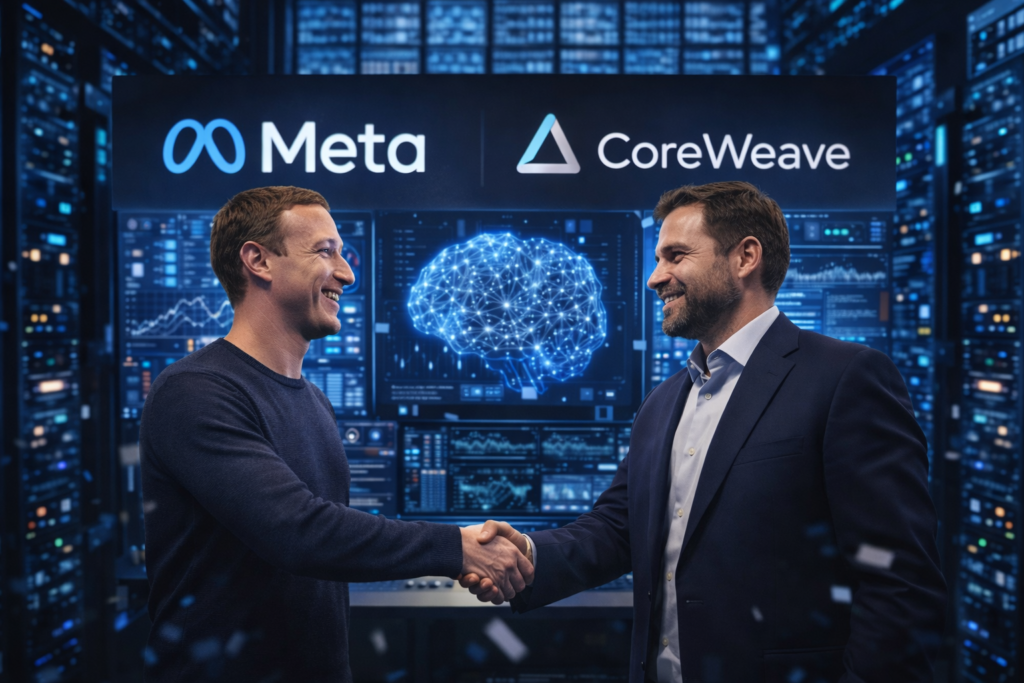
For a market that keeps asking when the AI spending binge will cool off, Meta just gave a very loud answer: not yet. On April 9, CoreWeave and Meta announced an expanded AI infrastructure agreement worth about $21 billion through December 2032. It is not a small add-on. It sits on top of Meta’s earlier $14.2 billion CoreWeave deal from September, and it arrives while Meta is still guiding for a staggering $115 billion to $135 billion in 2026 capital expenditures. That is why this deal matters. It says the AI arms race is still all-in, even after months of investor hand-wringing about returns, margins, and whether the whole boom is moving too fast.
The scale alone would make this notable. The timing makes it more important. Meta’s latest move comes just after the company rolled out Muse Spark, the first model from its retooled superintelligence effort, and after its earlier Llama 4 push was widely seen as underwhelming. In plain English, Meta is not spending like a company that thinks it can afford to pause and regroup. It is spending like a company that believes compute capacity is now strategic terrain.
That is the real story here. This is not just another cloud contract. It is a giant signal that the competitive bottleneck in AI is still infrastructure.
This deal is really about locking down scarce compute
CoreWeave’s own announcement makes the use case explicit. The new agreement is for AI cloud capacity through December 2032, deployed across multiple locations, and it will include some of the initial deployments of Nvidia’s Vera Rubin platform. CoreWeave also said Meta will use the capacity to scale inference workloads. That last point matters. This is not only about training ever-bigger models in the lab. It is also about serving AI systems at scale once they are live inside products.
That distinction helps explain why the number is so big. Training gets headlines because it sounds dramatic. Inference is where the real operating burden often shows up once hundreds of millions or billions of users start hitting AI tools repeatedly. If Meta wants AI deeply embedded across Facebook, Instagram, WhatsApp, Messenger, Meta AI, smart glasses, and whatever comes next, then capacity cannot be treated as a nice-to-have. It becomes recurring infrastructure. CoreWeave’s statement and Reuters’ reporting both point in that direction.
So the deeper message is simple: the arms race has moved beyond “who has the smartest model” into “who can guarantee enough compute to keep their AI products fast, cheap enough, and always on.” That is a much more capital-intensive contest.
Read the latest posts from Finance XP
News about economics, investments, politics, and everything that can affect your portfolio, at Nerd XP.
- OpenAI’s Ad Business Just Became a Finance Story
 For a while, OpenAI’s ads looked like a product experiment. Now they look like capital-markets… Leia mais: OpenAI’s Ad Business Just Became a Finance Story
 - Defense IPO Mania Is Heating Up Again
 Most IPO booms need a clean macro story. Lower rates help. Stable markets help. Happy… Leia mais: Defense IPO Mania Is Heating Up Again
 - Meta’s $21B CoreWeave Deal Says AI Is Still All-In
 For a market that keeps asking when the AI spending binge will cool off, Meta… Leia mais: Meta’s $21B CoreWeave Deal Says AI Is Still All-In
Meta is buying speed, not just servers
There is a reason Meta keeps leaning on outside infrastructure partners even while it pours tens of billions into its own footprint. Building everything in-house sounds cleaner on paper. In practice, it is slower, riskier, and constrained by power, land, supply chains, and construction timelines. Meta’s 2026 capex outlook says most of its expense growth will be driven by infrastructure, including third-party cloud spend, higher depreciation, and higher infrastructure operating expenses. That is a direct admission that outsourcing and owned infrastructure are now part of the same strategy, not opposites.
CoreWeave’s announcement reinforces that logic. The distributed deployment across multiple locations is designed around performance, resilience, and scalability. Meta is effectively paying for time. Instead of waiting for every new data center and chip deployment to arrive on its own schedule, it is locking in a partner that already lives inside the Nvidia-heavy AI supply chain. Reuters said the deal gives Meta access to Nvidia’s Vera Rubin chips, which are expected to be materially faster than the current Blackwell generation. That is not just capacity. It is a queue-jumping strategy.
This is why the deal feels like an arms-race headline rather than a plain procurement note. When companies start pre-booking years of next-generation compute, they are acting like infrastructure shortages are competitive threats, not temporary inconveniences.
The rest of Big Tech is behaving the same way
Meta’s move would be impressive on its own. It becomes more revealing when placed beside what the rest of Big Tech is doing. Reuters reported in February that Alphabet, Microsoft, Amazon, and Meta were expected to spend more than $630 billion combined in 2026, largely on AI. Amazon alone now projects about $200 billion in 2026 capex, mainly focused on AI infrastructure. Alphabet has guided to $175 billion to $185 billion in capex for 2026. Meta has guided to as much as $135 billion. This is not one company losing discipline. It is an industry-wide posture.
Amazon’s update on April 9 may be the clearest cross-check. Andy Jassy said AWS’s AI services are now running at more than $15 billion in annualized revenue, while Amazon’s custom chip business has surpassed a $20 billion annualized run rate. He also made clear that Amazon is not spending on a hunch and already has substantial customer commitments for much of that capex. Investors liked the disclosure enough to push Amazon shares up 4.5%. That matters because it shows that, at least for now, the market is still willing to reward giant AI spending when it sees some monetization underneath it.
Google is behaving the same way from another angle. Reuters reported this week that Broadcom signed a long-term deal through 2031 to help develop and supply Google’s custom AI chips. Google is also using those chips to support Anthropic capacity commitments. That is the same logic in a different wrapper: if compute is strategic, the winning move is not thrift. It is securing the stack early.
So yes, Meta’s $21 billion deal is huge. More importantly, it fits a pattern. The leaders are not stepping back. They are entrenching.
Meta’s spending says it still believes it has something to prove
This is where the article gets more interesting than just “Big Tech spends a lot.” Meta’s move also says something about where the company believes it stands in the race.
Reuters framed the new CoreWeave agreement as part of Meta’s effort to catch up after a disappointing Llama 4 cycle. The company has since reorganized around Meta Superintelligence Labs and launched Muse Spark, a new model meant to reset the narrative. That means the CoreWeave deal is not coming from a position of obvious dominance. It is coming from urgency. Meta is acting like it cannot afford another year where model quality, deployment speed, or infrastructure bottlenecks leave it looking second-tier next to OpenAI, Google, Anthropic, or even parts of Microsoft’s ecosystem.
That urgency is visible elsewhere too. Reuters reported in March that Nebius signed AI infrastructure agreements with Meta worth up to $27 billion over five years, including $12 billion of dedicated capacity by 2027 and the option for another $15 billion. Read together, the Nebius and CoreWeave deals show Meta is not relying on a single partner or a single route to capacity. It is building redundancy. That is what a company does when it thinks the race will be won partly by who can keep scaling, not just who can demo well.
In other words, Meta’s strategy increasingly looks like this: spend heavily enough that infrastructure never becomes the excuse.
CoreWeave is a second story hiding inside the first
This deal also tells a major story about CoreWeave itself. Reuters said Microsoft accounted for 67% of CoreWeave’s revenue last year. A customer concentration problem that big always makes investors nervous, especially when the company is also carrying heavy financing needs. So a fresh $21 billion Meta deal does two things at once. It validates demand for CoreWeave’s service model, and it helps diversify the business away from being seen as a near-one-client machine.
But there is a catch, and it matters. CoreWeave’s business is still brutally capital hungry. Reuters reported on March 31 that the company secured $8.5 billion in financing to expand its AI cloud platform, bringing its total equity and debt financing commitments over the prior 12 months to about $28 billion. Reuters also reported on April 9 that CoreWeave plans to raise another $4.25 billion through bond and convertible bond sales and expects to spend up to $35 billion in capital expenditures in 2026, more than double 2025 levels.
That means Meta’s deal is bullish for demand, but it also underlines the enormous financial intensity of serving that demand. The AI arms race is not just a software race. It is a financing race, a power race, and a balance-sheet race.
The market’s debate has shifted, not disappeared
None of this means investor skepticism has vanished. Reuters noted earlier this year that more than $630 billion of combined AI spending by Big Tech was sharpening scrutiny over returns and whether the outlays can be justified. That debate is still alive. In fact, it may get louder as capex keeps rising.
What changed is the shape of the debate. The question is no longer “Are the leaders really still spending this aggressively?” Meta just answered that. The question is now “Which forms of AI infrastructure spending turn into real product traction and revenue, and which ones become expensive overbuild?” Amazon’s disclosure gives one bullish answer. Meta’s deal gives a more aggressive, less patient one: even if the payoff is not fully visible yet, losing on capacity may be worse than overspending on it.
That is why this story matters beyond one contract. It tells investors that the industry’s top players still see the opportunity as large enough, and the competitive penalty for hesitation as severe enough, to justify writing multi-decade-style infrastructure checks right now.
Read the latest posts from Nerd XP
Stay up-to-date on the latest news in the world of finance, geek culture, and skills.
- OpenAI’s Ad Business Just Became a Finance StoryFor a while, OpenAI’s ads looked like a product experiment. Now they look like capital-markets… Leia mais: OpenAI’s Ad Business Just Became a Finance Story
- Defense IPO Mania Is Heating Up AgainMost IPO booms need a clean macro story. Lower rates help. Stable markets help. Happy… Leia mais: Defense IPO Mania Is Heating Up Again
- Global Engagement Falls While AI Job Fear Rises
 A lot of workers are not just tired right now. They are uneasy. That matters… Leia mais: Global Engagement Falls While AI Job Fear Rises
 - Meta’s $21B CoreWeave Deal Says AI Is Still All-InFor a market that keeps asking when the AI spending binge will cool off, Meta… Leia mais: Meta’s $21B CoreWeave Deal Says AI Is Still All-In
- Wednesday Season 3 Is Today’s Cleanest Fandom Spike
 Not every fandom surge is created equal. Some feel messy, rumor-driven, or weirdly over-engineered. Wednesday… Leia mais: Wednesday Season 3 Is Today’s Cleanest Fandom Spike
 - The Relief Rally Just Ran Into Fragile Ceasefire Risk
 Wednesday’s market message looked simple: ceasefire, oil down, stocks up, panic over. Thursday’s market message… Leia mais: The Relief Rally Just Ran Into Fragile Ceasefire Risk
What ordinary investors should take from this
First, stop thinking of AI spending as mainly a chip story. Chips matter, of course. But this deal shows the more durable bottleneck is integrated capacity: cloud access, data-center buildout, power, networking, and the ability to serve inference at scale. That is why the money keeps flowing beyond Nvidia itself.
Second, this is a reminder that “all-in” does not just mean more capex at the hyperscalers. It also means giant downstream commitments to neocloud providers like CoreWeave and Nebius, plus fresh financing structures to fund the build. When Meta signs $21 billion here and up to $27 billion there, it is effectively saying the market for AI compute is too important to leave to short-term availability.
Third, investors should separate two truths that can exist at the same time. One: AI infrastructure demand is still red hot. Two: the financial and execution risks are enormous. CoreWeave’s financing load, the sector’s power constraints, and ongoing investor concern about return on capital all remain real. So this is not a simple “buy everything AI” message. It is a clearer signal that the biggest companies in the race still think the answer to uncertainty is more capacity, not restraint.
The bottom line
Meta’s new $21 billion CoreWeave deal says the AI arms race is still all-in because it is not a cautious bridge contract or a symbolic extension. It is a long-dated, next-generation compute commitment tied to inference scale, Nvidia’s Vera Rubin platform, and a company that is already guiding up to $135 billion in 2026 capex. It also lands in a market where Amazon is still spending about $200 billion, Alphabet is targeting up to $185 billion, and Big Tech as a group is still expected to pour more than $630 billion into AI this year.
The smartest read is not “Meta got excited again.” It is that the leaders still believe compute scarcity is a bigger risk than overspending. That is a powerful message for markets, because it means the AI buildout is still being treated as strategic necessity, not optional expansion. If investors were waiting for the arms race to cool off, Meta just told them the opposite.
HypeBucks
XP of the Day: When one company guides up to $135 billion in annual capex and still signs another $21 billion external compute deal, the bottleneck is not ambition. It is capacity.
Next Move: Spend 10 minutes comparing Meta, Amazon, and Alphabet on one metric only: planned 2026 capex versus the clearest AI revenue or product traction each has publicly shown.