

A spice rack is not supposed to feel like a market-moving asset. Yet on March 31, 2026, McCormick and Unilever made flavor a real Wall Street conversation. Their deal to combine Unilever’s foods business with McCormick was valued at about $65 billion including debt, would create a company with roughly $20 billion in 2025 revenue, and instantly reframed sauces, seasonings, and condiments as more than grocery-store basics.
That matters because investors were not really reacting to pepper, bouillon, or mayonnaise. They were reacting to what flavor now represents in consumer goods: pricing power, premiumization, healthier eating trends, and the search for growth in a packaged-food market that has looked slow, crowded, and increasingly private-label driven. Reuters reported that both stocks dropped after the announcement, which tells you the market saw opportunity here, but also a lot of risk.
So the real story is bigger than condiments. McCormick and Unilever just showed that “flavor” has become shorthand for a full investment thesis.
Why this deal got Wall Street’s attention
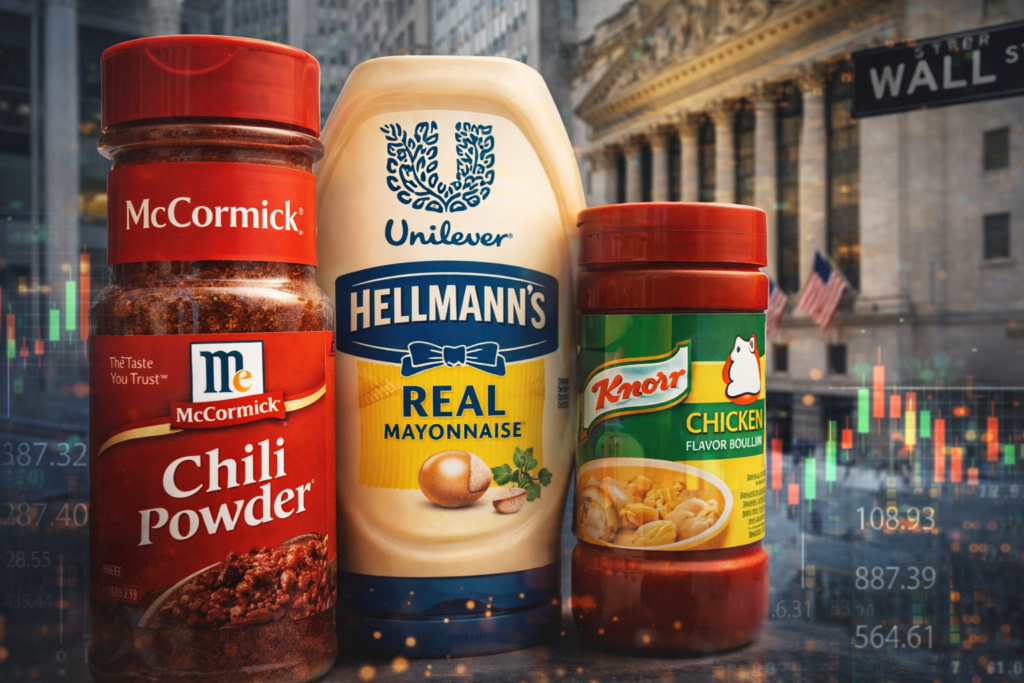
First, the scale was impossible to ignore. Unilever said the combined business would include brands such as McCormick, Knorr, Hellmann’s, Cholula, Maille, and Frank’s, with about $20 billion in revenue based on 2025 results. Unilever and its shareholders would own 65% of the combined company, while Unilever itself would also receive $15.7 billion in cash. The structure is meant to help Unilever become a more focused home, beauty, and personal-care company.
That alone would have been enough for investors to pay attention. However, the market reaction showed that size is not the same thing as simplicity. Reuters reported that Unilever shares fell 7% and McCormick shares fell about 5% after the deal was announced, as investors worried about the long path to closing, the complexity of the Reverse Morris Trust structure, and the chance of antitrust scrutiny. The companies do not expect the transaction to close until mid-2027.
In other words, Wall Street heard two stories at once. One was a clean strategic narrative about building a global flavor powerhouse. The other was a much messier story about execution risk. That tension is exactly why this became a market story instead of just an industry headline.
Flavor now means pricing power
The biggest reason flavor matters to investors is simple: these products can defend margins better than many other food categories.
McCormick’s latest results made that point clearly. In its first quarter of 2026, net sales rose 16.7%, while organic sales grew 1.2%. Adjusted operating income rose 18.8%, and adjusted gross margin expanded 100 basis points. Consumer organic sales increased 2% and Flavor Solutions organic sales rose 1%, both driven by price. At the same time, higher commodity costs were still a headwind.
That mix matters. It says McCormick is not just selling more units. It is showing the kind of pricing resilience that investors love in an uncertain economy. When a company can raise prices, protect margins, and still keep demand from falling apart, Wall Street tends to assign more value to that business. In effect, flavor is being treated like a small but powerful layer of consumer spending that people are still willing to pay up for.
There is also a second margin story here. Reuters noted that McCormick sources key raw materials, including pepper and other spices and herbs, from outside the United States, and that half of the incremental tariffs on its products were still in place as of last quarter. Even with that pressure, the company beat revenue expectations and kept its 2026 outlook intact. That makes flavor look less like a fragile grocery category and more like a business with some real shock absorption.
Health trends did not kill flavor. They may have made it stronger.
For years, investors treated packaged food as a category with too many problems and not enough growth. Health-conscious consumers were moving toward fresher food. Private labels were improving. More recently, GLP-1 weight-loss drugs added a new fear: what happens if people simply eat less?
McCormick’s answer is surprisingly smart. Instead of fighting the health shift, it is trying to ride it. Reuters reported that management argued flavor would remain essential even as consumers eat fewer calories, cook more at home, add more protein and produce, and look for healthier meals that still taste good. That is a powerful idea because spices, hot sauces, seasonings, and condiments can improve the eating experience without acting like the old “junk food” growth engine packaged-food investors have become wary of.
That does not mean the company is suddenly immune to market pressure. Reuters also reported that McCormick’s total volume growth slowed over the past year and was down 0.7% in the most recent quarter. So the demand story is not perfect. Still, the strategic bet is easy to understand: when consumers cut calories, they may not want less taste. They may want more of it.
From an investing standpoint, that makes flavor look like a category with better cultural fit than many old packaged-food businesses. It can sit closer to wellness, home cooking, and global taste trends than legacy processed food can. That is exactly the kind of repositioning public companies want investors to notice.
Why Unilever wanted out of food
This story is not just about McCormick getting bigger. It is also about Unilever deciding that food no longer fit the company it wants to be.
In Unilever’s full-year 2025 results, the company said group underlying sales growth was 3.5%, while Foods grew only 2.5%. Developed-market Foods growth was flat, even though Hellmann’s continued to perform well. Meanwhile, Unilever said it expects 2026 growth at the bottom end of its 4% to 6% multi-year guidance range, which shows why management wants sharper focus and faster-growing categories.
The company’s own framing is blunt. Unilever said the transaction would leave it as a pure-play HPC business with about €39 billion in 2025 revenue, focused on beauty, wellbeing, personal care, and home care. Reuters reported that CEO Fernando Fernandez described this as the right step to build a simpler, sharper, higher-growth Unilever. Investors have pushed for that kind of simplification for years.
That helps explain why flavor became a Wall Street story from both sides. For McCormick, flavor is a growth platform. For Unilever, food had become a lower-growth drag on the valuation story. Same asset class, two very different messages.
Read more posts from Nerd XP
Stay up-to-date on the latest news in the world of finance, geek culture, and skills.
- Central Banks Are Spelling Out a Multi-Asset Risk Map
 Most investors still talk about risk one shelf at a time. Stocks are risky. Bonds are defensive. Credit is someone else’s problem. Central banks are telling a different story now. Their latest warnings read less like isolated market commentary and… Leia mais: Central Banks Are Spelling Out a Multi-Asset Risk Map
 - Xbox and Gears Still Have Real Momentum
 For all the talk that Xbox has become too scattered, too platform-agnostic, or too far removed from the old console-war script, today tells a different story. Microsoft just announced that its June 7 Xbox Games Showcase will be followed immediately… Leia mais: Xbox and Gears Still Have Real Momentum
 - TikTok Wants to Be a Lender, Not Just a Platform
 For years, the TikTok story was simple: attention first, ads second, shopping maybe third. That model is changing fast. Reuters reported on March 31 that TikTok is seeking approval from Brazil’s central bank for two licenses that would let it… Leia mais: TikTok Wants to Be a Lender, Not Just a Platform
 - Portfolio Careers Beat the Side-Hustle Fantasy
 For years, people were sold a very specific dream. Start a side hustle. Work nights for a while. Then escape your job, replace your income, and finally control your life. That dream still sounds good. However, real life keeps exposing… Leia mais: Portfolio Careers Beat the Side-Hustle Fantasy
 - Why McCormick and Unilever Put Flavor on Wall Street
 A spice rack is not supposed to feel like a market-moving asset. Yet on March 31, 2026, McCormick and Unilever made flavor a real Wall Street conversation. Their deal to combine Unilever’s foods business with McCormick was valued at about… Leia mais: Why McCormick and Unilever Put Flavor on Wall Street
 - Private Credit Stress Is Getting Visible
 For a long time, private credit’s biggest danger was that you could not see it clearly. That was the trade. Investors got higher yields, smoother marks, and less daily market noise. In return, they accepted opaque portfolios, illiquid structures, and… Leia mais: Private Credit Stress Is Getting Visible
Why investors still sold first
If the strategic logic sounds solid, why did the stocks drop?
Because public markets care about the path, not just the pitch.
Reuters said investors were worried about the transaction’s structure, the long timeline, and regulatory risk. Analysts also pointed out that this was not a clean Unilever exit, since Unilever shareholders would still own a large chunk of the combined business. Add in the general reality that very large consumer packaged-goods deals often look better on slides than in execution, and the initial skepticism makes sense.
There is also a simpler explanation. McCormick’s latest reported growth was helped heavily by its January 2026 acquisition of McCormick de Mexico. The company’s 2026 guide calls for 13% to 17% net sales growth, but 11 to 13 percentage points of that is expected to come from that acquisition. Its organic sales growth outlook is just 1% to 3%. So investors are being asked to believe in a much bigger flavor empire at a time when the underlying organic growth is still modest.
That is why the market reaction was rough. Wall Street is not denying that flavor matters. It is questioning how much investors should pay today for a story that may take years to prove out.
What ordinary investors should take from this
The practical lesson here is not “go buy a spice stock.” It is broader than that.
When a category like flavor becomes a market story, investors should look for three things. First, check whether the company has real pricing power or just temporary price hikes. McCormick’s margin performance suggests there is something real there, although volume trends still need watching.
Second, ask whether the category fits how consumers are actually changing. Flavor looks better positioned than many packaged-food niches because it can benefit from healthier eating, home cooking, and global taste preferences at the same time. That makes it more adaptable than categories built around old convenience habits alone.
Third, separate the business story from the deal story. The business case for flavor may be strong. The deal case can still be risky. Integration, antitrust review, timing, and ownership structure all matter. That is why a great narrative can still produce a bad short-term stock reaction.
That last point is the one many beginners miss. Wall Street is not a movie critic handing out stars for a compelling plot. It is more like a raid group checking whether the build actually works under pressure. Good concept. Fine. Show the numbers, the timing, and the execution.
The bottom line
McCormick and Unilever made flavor a Wall Street story because flavor now sits at the intersection of several trends investors care about: pricing power, margin defense, healthier eating, premiumization, and portfolio focus. McCormick sees a chance to own more of a global taste platform. Unilever sees a chance to leave slower-growth food behind and chase a cleaner valuation story in beauty and household products.
The market did not celebrate right away, and that reaction was rational. Big consumer deals are hard. Organic growth is still modest. Regulators may take a close look. Yet the message underneath the volatility is important: in 2026, “flavor” is no longer just a grocery-shelf detail. It is a way investors talk about resilience, relevance, and where growth might still exist in a tougher consumer economy.
For everyday readers, that is the useful takeaway. Sometimes the smartest market signal is not in a flashy new technology or a meme stock. Sometimes it is hiding in the pantry.
HypeBucks
XP of the Day: A company growing sales 15% from acquisitions but only 1% to 3% organically deserves a different valuation lens.
Next Move: Pull up one consumer-staples stock you follow and separate its reported growth into price, volume, and acquisition effects.